Business
Minister calls on World Bank to fast-track Lobito Corridor forest project
Minister of Green Economy and Environment, Gilbert Siame, has urged the World Bank Group to accelerate the design and development of the Lobito Corridor Integrated Forest Economy (LIFE) Project to pave the way for its implementation. Siame said expediting the project design would enable the…
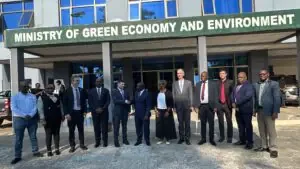
Picture: Zambia Monitor
Minister of Green Economy and Environment, Gilbert Siame, has urged the World Bank Group to accelerate the design and development of the Lobito Corridor Integrated Forest Economy (LIFE) Project to pave the way for its implementation.
Siame said expediting the project design would enable the parties to conclude the project agreement and move towards implementation.
The Minister made the call in Lusaka on Thursday when he met a World Bank Group delegation at his office.
The meeting followed a joint Government and World Bank exploratory mission to the Copperbelt undertaken recently, which enabled the two parties to engage forest companies, communities and other stakeholders.
Siame commended the World Bank for its partnership with the Government and called for deeper cooperation in the forestry sector as the two parties worked towards developing an effective implementation model for the LIFE Project.
Lakatips
For Zambian newsrooms
Your reporting, credited and linked back
Join the newsrooms whose work reaches readers through Lakatips — your name on every story, and a route straight back to you.
“We need to accelerate the design and outline of the LIFE Project so that we can conclude the project agreement and move towards implementation,” he said.
He said finalising the agreement would help strengthen the forestry sector and stimulate economic growth along the Lobito Corridor, particularly as the project aligned with the Government’s Grow Zambia agenda.
World Bank Group Country Manager for Zambia Martine Valcin said the Copperbelt mission had been fruitful and enabled the delegation to engage forest companies, communities and other stakeholders.
“The mission gave Government and the Bank a clearer understanding of how they can collaborate to support the forest economy along the Lobito Corridor,” Valcin stated.
The delegation was led by Valcin and included senior natural resources specialists.
World Bank Lead Natural Resources Management Specialist for Eastern and Southern Africa Laurent Debroux said there was significant potential to support value-added processing in the forestry sector, which could create jobs and empower communities along the corridor.
“Several companies visited during the mission are already planning to expand their plantations and invest in value addition and this development is encouraging for the sector,” Debroux stated.
World Bank Senior Natural Resources Management Specialist for Africa East and South Andrew Zakharenka said the delegation would meet the Forestry Department the following week to agree on the design of the LIFE Project, drawing on findings from the Copperbelt mission.
He said the meeting would take place ahead of the finalisation of the project agreement.
The proposed LIFE Project seeks to develop a sustainable forestry economy in Zambia by creating jobs, increasing local value addition, attracting responsible private investment and expanding economic opportunities for communities.
Envisaged as a phased, private sector-led initiative, the project would support sustainable plantations, outgrower arrangements, domestic processing and market development, while strengthening forest management systems.
Meanwhile, Zambia has launched the Miombo Thrive movement to turn landscape restoration into opportunity for people and nature following increasing pressure from deforestation and degradation, climate change and growing demand for land, food, water and timber.
The Miombo woodlands are the world largest tropical dryland ecosystem, covering an estimated 2.7 million square kilometres and supporting more than 300 million people.
At the same time, millions of people across the region depend on these landscapes for their livelihoods and wellbeing, however the woodlands also face pressure from unsustainable natural resource use.
Government representatives, communities, development partners, civil society, researchers, private sector actors and financing partners convened at Pamodzi Hotel in Lusaka on Friday for the launch.
Speaking during the launch, SNV Zambia and Zimbabwe Country Director Lucy Fulgence stressed that successful restoration should deliver benefits for both ecosystems and the people whose livelihoods depend on them.
She said restoration should make economic sense for communities and the Thrive Movement was about connecting what already works, addressing what none of the stakeholders can solve alone.
“The movement seeks to change how landscape challenges are addressed by connecting conservation with livelihoods, markets, finance and governance,” Fulgence stated.
WARNING! All rights reserved. This material, and other digital content on this website, may not be reproduced, published, broadcast, rewritten or redistributed in whole or in part without prior express permission from ZAMBIA MONITOR.
Source: Zambia Monitor — Read more
More to read
All Business →
HH Targets Doubling Zambias Economy
President HAKAINDE HICHILEMA has set an ambitious target of more than doubling the size of...
Govt Calls for Business Support on 24-Hour Economy
Government says stronger collaboration with the private sector will be critical to...

You can’t grow an economy that’s being looted-AG report exposes the rot
Zambia has swept the Auditor General’s 2025