Business
What should happen when a law made for Zambians begins to injure its own citizens?
While foreign-owned mining companies often thrive and
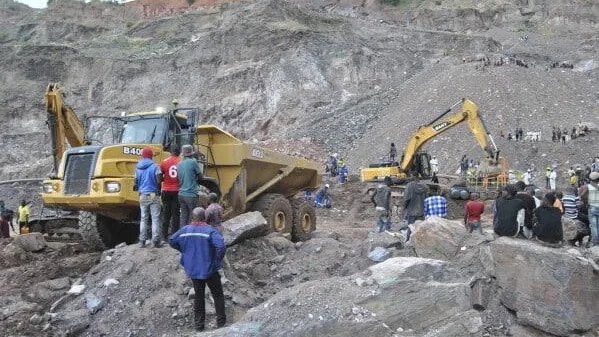
Picture: Zambian Business Times
While foreign-owned mining companies often thrive and expand in Zambia, many homegrown firms struggle under the weight of complex laws and costly compliance requirements. Zambia’s local miners continue to face significant challenges that hinder their potential for growth, often pushing them toward illegal activities under overwhelming pressures.
Local miners are now asking: What should happen when laws meant to benefit Zambians end up injuring their own citizens? Zambia’s local miners are yet again raising the concern over regulatory hurdles and soaring environmental fees that are threatening the growth and viability of the country’s homegrown mining sector.
The Emerald and Semi-Precious Miners Association of Zambia (ESMAZ) specifically has voiced deep concern over recent changes introduced by the Zambia Environmental Management Agency (ZEMA) under the Environmental Impact Assessment (EIA) Regulations, Statutory Instrument No. 3 of 2026.
According to ESMAZ, “the revised fee structure, specifically a 527% increase in the environmental assessment fee for smallscale miners, now set at over K106,600, risks crippling the gemstone industry.
Many local miners, already facing significant operational challenges, say the new financial burden may force them out of legal operations and into the informal sector.” Kalesha expressed disappointment with ZEMA’s slow response to the concerns of smallscale miners, calling for urgent intervention from the Minister of Green Economy and Environment as well as the Republican President.
Lakatips
Advertise on Lakatips
Reach readers following the national conversation
Display, sponsored placements and briefing slots — across politics, business and sport.
He described the flat fee for gemstone mining under Class III, regardless of the scale of operation, as “exorbitant and beyond the reach of ordinary Zambians.” He noted that, “under the new regulations, a full Environmental Impact Assessment costs a minimum of K236,666.40, with K106,666.40 paid directly to ZEMA.Even the Environmental Project Brief (EPB) now comes with a fee of K5,333.20. Many small-scale miners simply cannot afford these costs, making it increasingly difficult to process licenses and operate legally.”
Although ZEMA has defended the changes, stating that the revised fees are based on an impact-based regulatory framework, aiming to calibrate fees according to genuine environmental and social risks, ESMAZ insists that this approach is hurting local businesses, stifling job creation, and undermining national economic interests.
Kalesha acknowledged recent government action to dissolve the ZEMA board, but argued that further reforms, including changes in senior management, are needed to bring real efficiency and responsiveness to the agency.
He called on ZEMA’s leadership to engage directly with smallscale miners and work toward practical solutions, rather than hiding behind regulatory barriers.
Kalesha cited other public institutions as examples of how regulators can protect national interests while still listening to and supporting Zambian citizens.
Article by Tyndale Muchiya
Source: Zambian Business Times — Read more
More to read
All Business →
Illegal mining activities booming in Chingola’s residential areas
Questionable mining activities are booming in Chingola’s
HH Urges Mining Licence Holders to Develop Mines
& Sharon Siame President HAKAINDE HICHILEMA has urged mining licence holders to...
Chinese-owned NFC Africa mine denies gold mining at Chambishi copper mine
NFC Africa Mining Plc (NFCA), a Chinese-owned