Agriculture
If fluctuating tomato prices are a trend, why are farmers still losing out?
According to a check done by the
Picture: Zambian Business Times
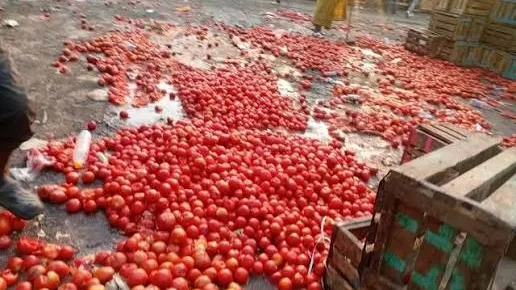
According to a check done by the Zambian Business Times in one of Zambia’s largest vegetable markets, tomato prices are reported to have dropped to K10 per box.
A check on prices by ZBT at Soweto Market on September 7 and 8, 2026, shows tomato prices have fluctuated to as low as K10 per box, with the highest prices reaching K60 and K100.
The crash comes after months of much higher prices, when the same box of tomatoes was trading between K250 and K300, leaving farmers facing a sharp reversal in earnings.
However, some stakeholders have described the fluctuations as a recurring trend, arguing that tomato prices have historically moved with seasonal supply and that farmers who understand the cycle should plan accordingly.
Speaking in an interview with Zambian Business Times-ZBT, agronomist Clever Munsunge said the fluctuations are not new, but farmers continue to suffer because knowing a trend and preparing for it are two different things.
Lakatips
The morning briefing
Zambia’s news, before your first meeting
One email each morning with the headlines that matter, from every newsroom we follow. Free, and one click to stop.
“Yes, tomato price fluctuation is a trend, and it has been happening for years, but the problem is that knowing a trend and preparing for it are two different things, and right now at Soweto Market we are seeing the law of supply and demand at work because too many farmers planted at the same time and are now harvesting and flooding the market at the same time,” said Munsunge.
He said simultaneous harvesting means large volumes of tomatoes are competing for the same buyers, pushing prices down regardless of the quality of produce reaching the market.
“When you have thousands of boxes of Grade A, B, and C tomatoes competing for the same buyers, prices must fall, and that’s why we are seeing K5, K10, K20, 25, and K60 per box, while farmers are still losing because production is not planned and most farmers plant once and pray instead of staggering their production,” said Munsunge.
He said high production costs and limited alternative markets further expose farmers when prices collapse, particularly because tomatoes are highly perishable and cannot be stored for long without appropriate facilities.
“Chemicals, fertilizer, and labor can cost between K10,000 and K15,000 to produce a lima of tomatoes, so when you sell at K25 per box, you cannot recover that, and because we don’t have enough cold rooms, processing plants, or contracted markets, farmers have nowhere else to go when Soweto is flooded except to sell at a loss or watch their tomatoes rot,” said Munsunge.
The agronomist noted that farmers who consistently produce throughout the year and stagger their planting stand a better chance of surviving the repeated price swings than those who depend on a single harvest.
“Tomato will go from K5 today to K250 tomorrow and even K500 next month, so if you are in the field continuously, you average out, but if you plant once, you gamble once, and farmers are still losing because we are treating tomato farming like a seasonal gamble instead of a business that requires planning, storage, and market linkages,” he said.
Article by Philip Sinkala
Source: Zambian Business Times — Read more
More to read
All Agriculture →New Cattle Centre Boosts Sesheke Farmers
Cattle farmers in Maondo Chiefdom of Sesheke District in Western...

120 Tonnes of Soya Open Doors to China
CAMCO says Zambia’s first soybean consignment to China offers new market opportunities for local farmers...

Agro Input & Machinery Expo 2026 | Day 1 & 2 Highlights
Two days. One platform. A shared vision