Opinion Opinion
Bridging the Gap: A Zambian Student’s Reflections on China’s Smart Manufacturing
A Zambian student studying Artificial Intelligence at Zhejiang University of Science and Technology reflects on a visit to SUPCON Technology in China, where she saw how AI, automation and cybersecurity are being applied to improve industrial safety and efficiency.
Picture: Times of Zambia
As a Zambian student studying at Zhejiang University of Science and Technology, I had the opportunity to visit SUPCON Technology in Hangzhou as part of our Explore China course, during which we visited several companies. The purpose of these visits was to see how different sectors in China operate in practice and connect what we study in class to real-world applications. SUPCON was one of the visits that left the strongest impression on me.
Before visiting the company, I expected to see advanced machines and automation but I did not fully understand how much Artificial Intelligence is involved in managing modern industries. The visit gave me a chance to see how technology that we study in class is actually used to solve real industrial problems on a large scale.
SUPCON Technology is a company that deals with industrial automation and intelligent manufacturing. It was established in 1993 in Hangzhou, China, starting with a small engineering team and its first contract was a retrofit project at a nylon plant.
Today, SUPCON is known for developing distributed control systems (DCS), industrial software and AI-powered solutions that are used in industries such as petrochemicals, energy production and steel manufacturing. The company has grown over the past three decades and now operates internationally, with offices and clients across multiple countries.
We were given a tour of the company’s exhibition hall where they presented their products, history, and current projects. The guide walked us through different sections covering everything from how the company started to what they are currently working on.
Lakatips
Advertise on Lakatips
Reach readers following the national conversation
Display, sponsored placements and briefing slots — across politics, business and sport.
They explained how their systems are used to monitor and control entire industrial processes in real time, how they have integrated AI into their platforms, and how they approach safety and energy management in high-risk environments. The hall had interactive displays, live data screens, and case study panels showing real results from clients.
The exhibition was designed to show not only the company’s products but also how they solve real challenges faced by different industries. Seeing actual examples made it much easier to understand the impact of these technologies. Instead of only learning about automation in class, we could see how different systems work together to improve production, reduce downtime, and make industries operate more efficiently.
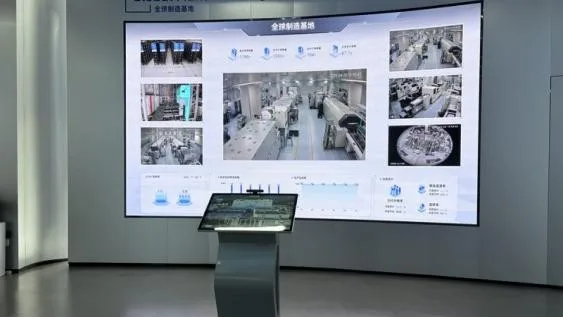
What caught my attention the most was how everything is monitored and controlled in real time on a single system. One display showed live production data from SUPCON’s own manufacturing operations, including active orders, units shipped, delivery rates, and live camera feeds from the factory floor, all visible on one screen.
Another section was dedicated to their AI+ Production Safety platform, which they had deployed in a chemical group in Shandong. The results showed a 30% reduction in alarm response time, a 15% reduction in labor costs, and a 20% improvement in control efficiency. The system uses AI to detect risks early, monitor hazardous conditions, and alert operators before problems become more serious.
The concept of applying AI to production safety was particularly interesting to me because I study Artificial Intelligence. In class, we work with algorithms, datasets, and model evaluation. What SUPCON showed me is a completely different set of demands. When AI is used in a chemical plant, a wrong prediction is not just a low accuracy score. It can mean a missed safety alarm with real consequences.
The system has to be reliable, fast, and explainable enough for an operator to trust it and act on it. I also found their AI cybersecurity architecture interesting. They have built autonomous AI tools that continuously test and defend their own industrial networks, including a Penetration Testing Robot and an AI Security Brain. That is not something I had thought about before, but it makes complete sense when the systems being protected are running actual factories.
During the visit, our teacher asked us a question about the state of industrial automation in our own countries. That question opened my mind a lot. Coming from Zambia, I know that industrial automation is still at an early stage back home.
Most industries, especially agriculture, rely heavily on manual labor. Even the mining sector, which is the most advanced industry in Zambia and has started adopting newer technology, is still far from the level of integration I saw at SUPCON.
Seeing everything monitored in real time on one system, with AI predicting failures and optimizing energy use, made me realize just how large the gap is. It also made me think about what would need to happen for countries like Zambia to move in that direction, not just importing the technology but also building the engineering knowledge and infrastructure to use it properly.
I also think universities have an important role to play in preparing students for that future. Learning programming, Artificial Intelligence, data analysis, and automation will become even more important as more industries adopt digital technologies. Experiences like this motivate students like me to keep improving our skills so that one day we can help bring similar technologies to our own countries.
This visit also made me think more seriously about the different career paths available in Artificial Intelligence. Before this visit, I mostly thought about AI in terms of software and machine learning. Now I understand that AI is also being used in manufacturing, energy, cybersecurity, and many other industries that people depend on every day.
Overall, the visit to SUPCON was one of the most educational experiences of this course. I learnt that industrial AI is not just about building a good model. It involves hardware, communication systems, safety engineering, cybersecurity, and deep knowledge of the specific industry being served. I also learnt that a company’s growth story matters. SUPCON started small in 1993 with limited resources and built something world-class over thirty years.
That is not something that happens by accident. I am genuinely grateful for the opportunity to visit and see this level of technology up close. It gave me a much clearer picture of where my field is heading and what it actually looks like when AI is put to serious use.
Source: Times of Zambia — Read more
More to read
All Opinion →
Blindbox Explained: Prices, Rarity and Secret Figures
A blindbox is sealed packaging that conceals a collectible from a defined series. The manufacturer generally displays the possible designs on the packaging or product listing, but buyers cannot select the exact figure inside a standard sealed box. Collections may feature designer toys, anime characters…

Scrolller: Smooth Reddit Media Browser Experience
Scrolller is an online platform and app designed for browsing Reddit’s media in a smooth, distraction-free way. Instead of Reddit’s text-heavy interface, it delivers an endless stream of high-quality images, GIFs, and short videos. With its clean layout and infinite scrolling format, Scrolller appeals to…

Meredith Schwarz: American Businesswoman and Professional
Meredith Schwarz is an American businesswoman and professional who is best known to the public for her past marriage to American media personality and political figure Pete Hegseth. What is Meredith Schwarz beyond this public recognition? She is a distinguished professional who has carved a…