Zambia
Grow Zambia: Where heritage meets 5 million tourist dream
There is a number that could redefine Zambia’s tourism story. Five million tourists crossing Zambia’s borders, filling hotels, boarding safari vehicles, walking through heritage sites and leaving behind experience, traditional ceremonies, tasting Zambian cuisine and carrying home memories of a country where the ghosts of…
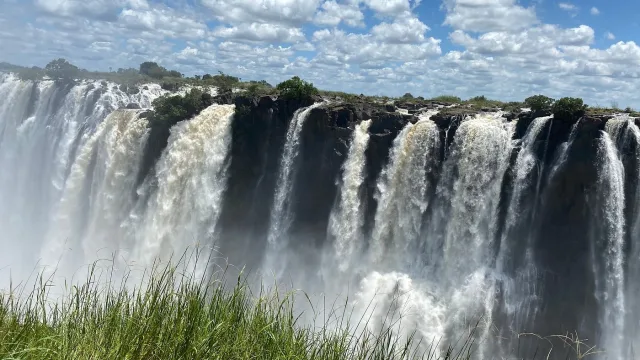
Picture: Times of Zambia
There is a number that could redefine Zambia’s tourism story.
Five million tourists crossing Zambia’s borders, filling hotels, boarding safari vehicles, walking through heritage sites and leaving behind experience, traditional ceremonies, tasting Zambian cuisine and carrying home memories of a country where the ghosts of history live in the same landscape, water, or rock, the story of a people who refused to be erased.
That is the scale of the tourism ambition embedded in President Hakainde Hichilema’s declaration of 2026 as The Year of Zambia’s Heritage.
And as the President begins his second term, his decision to adorn his Stadium has proved a significant statement. The football stadium is now called the Heroes Stadium.
“This mandate, therefore, belongs to the people of Zambia, to strengthen our democracy, to govern, to deliver services, and to build a prosperous, inclusive, and resilient nation. It is a mandate to Grow Zambia,” President Hichilema said in his address.
Lakatips
Advertise on Lakatips
Reach readers following the national conversation
Display, sponsored placements and briefing slots — across politics, business and sport.
The words carry significance beyond political rhetoric.
They set the tone for a second-term administration expected to accelerate economic transformation. Among the priorities standing out is the productive potential of sectors capable of creating jobs and growing wealth, tourism being top of the list.
The President was unequivocal in identifying tourism alongside mining, agriculture, energy and manufacturing as engines of growth and diversity.
But for Zambia to move towards the ambitious target of five million tourists, the country must look beyond the conventional tourism circuit that currently revolves around Livingstone, South Luangwa, Lower Zambezi, Kafue and Victoria Falls and their experiences.
It will have to tell its story.
That story is what defines a destination. Zambia’s heritage is everywhere, in its archaeological sites, historical monuments, landscapes, and its living traditions and communities. It is in the settlements, traditional architecture, cultural landscapes, indigenous knowledge systems, crafts, languages, dance, rituals and ceremonies that continue to define Zambian identity.
Yet, despite this heritage, Grow Zambia Agenda seems constrained by its own parameters. The two should not be viewed as separate platforms.
If tourism is expected to grow, then the heritage resources that provide authentic cultural experiences will have to be properly interpreted and developed sustainably. The country’s ambition to attract five million tourists a year cannot be realised without an evolution in how Zambia values its heritage.
For decades, heritage conservation has been presented as the preservation of tangible assets: the relics of past civilisations, the landscapes, the museum pieces and the fossilised past, the dry bones of history, the remains and historical sites for future generations.
That responsibility remains fundamental. But heritage is also an economic resource.
When properly interpreted and managed, a heritage site can become a centre of tourism activity, creating opportunities for tour operators, conservationists, filmmakers, researchers, guides, artisans, restaurants, artisans, performers, photographers, and communities.
It can be managed within the landscape and seascape. The visitor generates an economic chain that ripples outward.
This is why the National Heritage Conservation Commission’s role becomes increasingly important in the country’s tourism agenda.
The Commission headed by Mr Kagosi Mwamulowe is the country’s principal agency responsible for the identification, documentation, protection, conservation, and promotion of cultural and natural heritage. Its legal mandate is spelled out in the National Heritage Conservation Act, the principal piece of legislation governing the country’s heritage. It works to preserve, safeguard and promote places and objects of cultural significance and any biological, geological, ecological and landscape features.
The commission also undertakes inventory studies, develops conservation and management plans, promotes research, identifies and recommends sites and areas for registration as national monuments and heritage sites.
The commission’s broader aspiration for tourism development and conservation is to interpret these sites and relate them to their history, develop tourism at these sites while ensuring the sites remain relevant to the local communities.
The challenge is to treat the site as more than just a destination. It has to be accompanied by social programmes, storytelling, interpretation, tourism, educational, and research initiatives.
“Our mandate is to conserve heritage resources, document and preserve them and make sure that they are accessible for tourism purposes. We want the tourism sector to grow and heritage to contribute to national development. There is a lot of potential and we need to work together to make sure this is realised,” Mr Mwamulowe said.
There is also the African Museums Association, which supports the creation of museum associations, offers technical and financial support, and encourages cultural activities. It contributes to the development of African museums, aids in the recruitment and training of skilled personnel, and organises international and cultural activities. It promotes collaboration between African cultural institutions and museums and museum associations.
However, the growth of heritage tourism has not been reflected in the sector’s performance. Heritage tourism, as a percentage of total tourism revenue, remains small. That is because a visit to a heritage site is often seen as incidental, a minor attachment to a day of leisure, an afterthought and not a primary objective.
Yet heritage is not simply the past preserved in amber. It has to be presented in its historical, social and political contexts. The stories have to be told in a way that inspires a bigger vision, the story of a people, a nation, and the individual potential within each person. It has to have a sense of place, an experiential quality, a sense of mystery, a sense of wonder, a sense of discovery.
Heritage is also central to promoting a culture of conservation, both of the environment and of human societies, and to the development of tourism.
Zambia has a huge opportunity to improve its heritage sector. The economy is growing, the middle class is rising, and the demand for authentic, meaningful cultural experiences is increasing. But the country’s heritage sites have suffered from decades of under-investment, poor management and a lack of innovation and creativity.
Source: Times of Zambia — Read more
More to read
All Zambia →POLLEN Hails Progress on Kalomo Road
Government has expressed satisfaction with the progress made on the rehabilitation of the 27-kilometre...
The King of Morocco chairs a Council of Ministers
His Majesty the King of Morocco Mohammed VI accompanied by His Royal Highness the Crown Prince Moulay El Hassan, presided, this Saturday, October 17, 2026 at the Royal Palace in Rabat, a Council of Ministers dedicated to the examination and adoption of the general guidelines…
948 Teenage Pregnancies Recorded in Chadiza
The Chadiza District health office has recorded 948 teenage pregnancies between January...