Politics
The Dangerous Path of Terrorism and the Zambian Law- Chris ZUMANI
The Dangerous Path of Terrorism and the Zambian Law By Chris ZUMANI Zimba, TONSE ALLIANCE POLITICAL ADVISOR Anyone who knowingly aids, abets, assists, harbours, conceals or provides support to persons involved in terrorism or treason may themselves commit a serious criminal offence under Zambian law…

Picture: Zambian Observer
The Dangerous Path of Terrorism and the Zambian Law
By Chris ZUMANI Zimba, TONSE ALLIANCE POLITICAL ADVISOR
Anyone who knowingly aids, abets, assists, harbours, conceals or provides support to persons involved in terrorism or treason may themselves commit a serious criminal offence under Zambian law.
Under section 28 of the Anti-Terrorism and Non-Proliferation Act No. 6 of 2018, as amended, a person who “aids, abets, counsels, procures, incites or solicits” the commission of terrorism commits an offence. The amended provision further criminalises intentionally aiding, abetting or counselling a terrorist or designated or nationally listed person.
Further, section 30 specifically makes it an offence to harbour, conceal or provide a safe haven to a terrorist, terrorist organisation, or a person who finances or supports terrorism.
The position regarding treason is equally serious. Under section 44 of the Penal Code, Chapter 87 of the Laws of Zambia, a person who becomes an accessory after the fact to treason, or who knows that another person committed treason and aids them, commits the felony of misprision of treason, which carries liability to life imprisonment.
Therefore, where individuals are knowingly maintaining contact with persons lawfully wanted in connection with suspected terrorism or treason, whereby, it involves assistance, facilitation, concealment, logistical support or other conduct prohibited by law, they ought to know this is a criminal
Lakatips
The morning briefing
Zambia’s news, before your first meeting
One email each morning with the headlines that matter, from every newsroom we follow. Free, and one click to stop.
There is, of course, an important distinction where an accused person has been arrested, formally charged and brought before a competent court. Such a person remains entitled to legal representation and the protections afforded by the Constitution and the criminal justice system. Communication by lawyers, family members or other authorised persons in that lawful context should not automatically be equated with aiding or harbouring.
The critical issue, therefore, is not communication in itself, but is being communicated, for what purpose, and whether that communication knowingly facilitates, assists, conceals or supports criminal conduct or helps a wanted person evade lawful authorities.
In short, association to constitute an offender; but knowingly aiding, abetting, harbouring, concealing or supporting terrorism or treason suspects it is as taking sides and fullly participating
Source: Zambian Observer — Read more
More to read
All Politics →
‘No one should be unlawfully detained,’ Amnesty calls for lawyer access to Jay Jay Banda
Amnesty International Africa has urged Zambian authorities to facilitate a medical examination and access to a lawyer for former Petauke Member of Parliament Emmanuel “Jay Jay” Banda following his arrest and transfer to Zambia. Zambian authorities have confirmed that Banda, a former MP and government…

Bemba Royal establishment raises the alarm over alleged attempt to desecrate Kafwaya’s grave
The Bemba Royal Establishment has alleged that heavily armed people travelling in six vehicles were reportedly using threats and coercion to force villagers in Lisunga territory to show them the grave of the late Cabinet minister, Mutotwe Kafwaya. The Establishment said Bemba customary governance required…
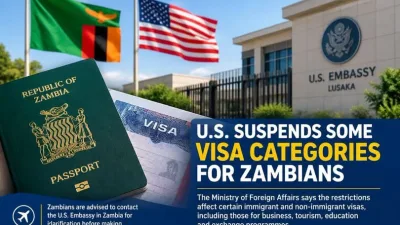
U.s. Tightens Visa Rules for Zambians
The Ministry of Foreign Affairs and International Cooperation says some Zambians are restricted from entering the United States under new travel measures that took effect on January 1, 2026. The restrictions affect people applying for immigrant visas and certain non-immigrant visas, including those for business…