Business
ZCSA withdraws over 5,600 unsafe products, Central Province tops violations
CENTRAL Province has recorded the highest number of non-compliant products during the Zambia Compulsory Standards Agency’s (ZCSA) 2025 nationwide market surveillance. According to ZCSA, this
Picture: Kalemba
CENTRAL Province has recorded the highest number of non-compliant products during the Zambia Compulsory Standards Agency’s (ZCSA) 2025 nationwide market surveillance.
According to ZCSA, this was largely due to high fertiliser use and local manufacturing activity at the time of the exercise.
Responding to journalists’ questions during its end-of-year media briefing in Lusaka, ZCSA executive director Gerald Chizinga said Central Province stood out because the surveillance targeted high-risk products that are widely consumed or produced in the region.
“The products we focused on included fertiliser, peanut butter and fruit-flavoured drinks, which are either heavily used or manufactured in Central Province,” Chizinga said.
He added that inspections were conducted during the farming season, when fertiliser usage peaks, and it seems like most farmers were buying substandard fertiliser.
Lakatips
Advertise on Lakatips
Reach readers following the national conversation
Display, sponsored placements and briefing slots — across politics, business and sport.
According to ZCSA, fertiliser standards require the product to be free-flowing to allow easy application in fields.
ZCSA manager for domestic quality monitoring Elias Kansembe said fertiliser that forms hard blocks becomes non-compliant because it can no longer be evenly applied to crops.
“This happens when fertiliser is exposed to moisture,” he explained.
“That is why fertiliser bags are required to have a plastic lining to prevent moisture from coming into contact with the [particles].”
Meanwhile, Chizinga highlighted some of the successes of the year which included the declaration of 41 new Zambian standards as compulsory in 2025, expanding the regulatory oversight to 102 products.
He said the move represented a 67 percent increase in products regulated under compulsory standards.
The new standards, which took effect on October 1, 2025, cover both locally manufactured and imported goods, including packaging materials, fertilisers, fish feed, food products, lubricants and fuels, beverages such as table wines and energy drinks, and construction materials including concrete blocks and steel reinforcement bars.
Furthermore, ZCSA, during this year’s nationwide Open Market Surveillance (OMS) exercise conducted between October 12 and December 5, 2025, covered all 10 provinces, including 61 districts and 108 localities, up from nine provinces covered in 2024.
During the exercise, inspectors assessed 41 product categories across 1,584 trading outlets and examined 1,925 product brands.
A total of 470 cases of non-compliance were recorded.
Common violations included administrative non-compliance such as lack of permits or certification, 176, cases, non-compliant electrical fittings 150, expired products, 50, banned or prohibited products, 43, poor labelling, 40, and the presence of foreign matter in products.
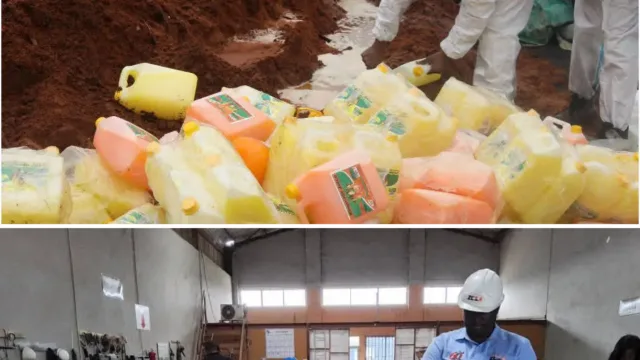
Chizinga added that as a result of the inspections, ZCSA withdrew 5,663 unsafe products from the market, including electrical fittings, potable spirits, rubber condoms, bottled water, fruit-flavoured drinks, household electrical appliances and packaged food products.
An additional 14,121 products were quarantined or restricted pending further verification, with bottled water, dishwashing liquid, fertilisers, potable spirits and sugar accounting for the largest volumes.
Chizinga said the total value of withdrawn products in 2025 was estimated at K440,645.89, a sharp decline from K818,039.19 recorded in 2024.
He attributed the reduction to improved compliance and increased awareness among market players.
Furthermore, the ZCSA stated that the overall compliance levels stood at 85.5 percent in 2025, down from 93.4 percent in 2024.
However, Chizinga said the decline should be viewed in the context of expanded surveillance.
“The number of OMS activities more than doubled, inspection days nearly tripled, and coverage widened significantly, enabling the identification of more non-conformities,” he said.
He added that Inspector-days also increased by 273 percent compared to 2024, reflecting enhanced monitoring capacity.
ZCSA pledged to enhance market surveillance, enforcement and public education in 2026, while encouraging consumers to report suspicious products and purchase goods only from trusted sources.
Source: Kalemba — Read more
More to read
All Business →
Y Celeb ft. Vocalist Zm – Dobo Video
Copperbelt rap heavyweight Y Celeb has released a new music video for his latest song, “Dobo,” a record that challenges the stereotypes society often attaches to people who smoke marijuana. The song questions the assumption that marijuana users cannot achieve success, highlighting how quick judgements…
Catholic priest Tyola, UPND’s Bwalya, reportedly reconcile
Catholic priest Father (Fr) Henry Tyola and United Party for National Development (UPND) official Frank Bwalya have reportedly reconciled following a dispute over alleged defamation and cyber-related abuse. Last week, Zambia Monitor reported that Bwalya, had threatened legal action against Fr Tyola over the alleged…

Zambia claims unemployment rate falls to 9.9%, as Western Province worst hit at 20.6%
Zambia’s unemployment rate fell to 9.9 percent in 2025 from 12.9 percent in 2024, while the employment-to-population ratio increased to 37.1 percent, according to the latest labour market survey. The findings were released during the official dissemination of the 2025 Labour Force Survey and Employment…