Business
BoZ Cuts Reserve Requirements: What Does This Mean for You? By Prof. Lubinda Haabazoka
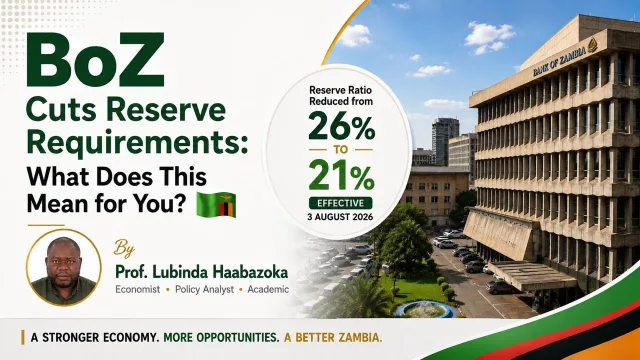
The Bank of Zambia (BoZ) has reduced the Statutory Reserve Ratio (SRR) on Kwacha deposits from 26% to 21%, effective 3 August 2026. At first glance, this sounds like technical banking language, but it is actually one of the most important monetary policy decisions made…
Picture: Mwebantu
The Bank of Zambia (BoZ) has reduced the Statutory Reserve Ratio (SRR) on Kwacha deposits from 26% to 21%, effective 3 August 2026
At first glance, this sounds like technical banking language, but it is actually one of the most important monetary policy decisions made this year because it signals that more money (liquidity) is about to enter the economy.
So, what exactly is the Statutory Reserve Ratio?
Every time you deposit money in a commercial bank, the bank is not allowed to lend out all of it. The Bank of Zambia requires banks to keep a certain percentage of deposits as reserves with the central bank.
Previously, for every K100 deposited, a bank had to keep K26 at BoZ and could only use K74 for lending.
Lakatips
Advertise on Lakatips
Reach readers following the national conversation
Display, sponsored placements and briefing slots — across politics, business and sport.
Now, with the reserve ratio reduced to 21%, the same bank only keeps K21 and can lend K79
That means an extra K5 out of every K100 deposited is now available for loans. Across the entire banking sector, this translates into billions of kwacha becoming available for businesses and households.
Why is BoZ doing this now?
To understand this decision, we need to look back.
Since 2021, the Bank of Zambia has pursued a relatively tight monetary policy to stabilise the economy. Inflation was high, the Kwacha was under pressure, foreign reserves were low, and investor confidence had weakened.
To restore stability, BoZ increased interest rates and maintained relatively tight liquidity conditions. These measures helped slow inflation, support the exchange rate, and rebuild confidence.
Today, the situation is different.
- Inflation has eased significantly.
- The Kwacha has become more stable.
- International reserves have grown to about US$6.7 billion, well above internationally accepted import cover benchmarks.
- Zambia has made substantial progress on debt restructuring.
- Investor confidence has improved.
With these macroeconomic fundamentals strengthening, the central bank is now gradually shifting from stabilising the economy to supporting economic growth.
What does this mean for ordinary Zambians?
More liquidity means commercial banks now have greater capacity to lend.
This could result in:
✅ More loans to businesses.
✅ Increased investment.
✅ Expansion of SMEs.
✅ More financing for agriculture, manufacturing and mining.
✅ Increased job creation.
✅ Stronger economic growth.
This does not mean banks will lend to everyone automatically. They will still assess borrowers based on creditworthiness and the viability of projects. However, the banking system now has more room to finance productive sectors of the economy.
Is this the same as printing money?
No.
BoZ is not creating new money.
Instead, it is allowing banks to use a larger portion of deposits that already exist instead of keeping those funds locked up as mandatory reserves.
It is a more efficient use of existing liquidity rather than an expansion through money printing.
The Bottom Line
The reduction in reserve requirements is more than just a banking adjustment. It is a strong signal that the Bank of Zambia believes the economy has become sufficiently stable to support greater lending and investment.
If commercial banks pass on this additional liquidity through increased credit to productive sectors, this decision could stimulate business expansion, create jobs and accelerate Zambia’s economic recovery.
In simple terms, after spending the last few years stabilising the economy, the Bank of Zambia is now beginning to fuel economic growth
That is why this announcement matters.
Source: Mwebantu — Read more
More to read
All Business →
SADC urges investment in disaster resilience and financing mechanisms
The Southern African Development Community (SADC) has called for increased investment in long-term disaster resilience and sustainable financing mechanisms to minimise losses, protect livelihoods and help countries recover more quickly from disasters. SADC Deputy Executive Secretary for Corporate Affairs, Dr Judith Kateera, said floods, droughts…

ZRA seizes goods worth K22.5 million, impounds three stolen vehicles
The Zambia Revenue Authority (ZRA) and partner law enforcement agencies have seized assorted goods worth an estimated K22.5 million and impounded three vehicles confirmed to have been stolen outside Zambia during joint operations conducted from October 5 to 9. The operations were carried out across…

Zambia urged to strengthen waste controls over microplastic pollution risks
Environmental health advocate, Christopher Mtonga, has warned that microplastic pollution poses a threat to Zambia’s aquatic ecosystems and public health, calling for stronger waste management and pollution control measures. In a statement issued in Lusaka on Sunday, Mtonga said public discussions had largely focused on…