Business
The Economy Is Like the Health of a Human Being: Macroeconomic Fundamentals Are the Body’s Vital Signs
When a patient walks into a hospital, the first thing a doctor does is not prescribe medication. Instead, the doctor conducts an examination by checking the patient’s vital signs. Blood pressure, pulse rate, body temperature, oxygen saturation, respiratory rate, blood sugar…
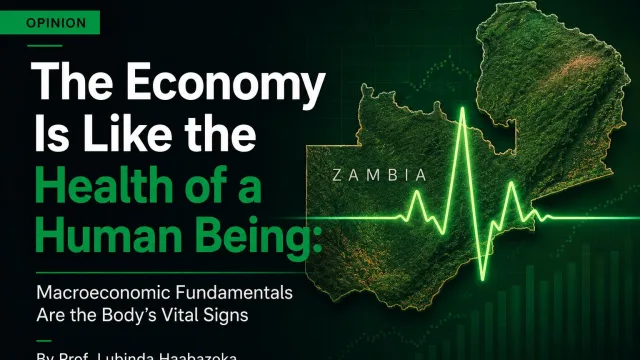
Picture: Mwebantu
By Prof. Lubinda Haabazoka
When a patient walks into a hospital, the first thing a doctor does is not prescribe medication. Instead, the doctor conducts an examination by checking the patient’s vital signs. Blood pressure, pulse rate, body temperature, oxygen saturation, respiratory rate, blood sugar levels, and laboratory tests all provide clues about the person’s underlying health. A patient may appear healthy on the outside yet be suffering from a life-threatening illness internally. Equally, someone recovering from a serious illness may still look weak even though their clinical indicators show remarkable improvement.
An economy functions in much the same way.
Macroeconomic indicators are the vital signs of a country. They tell economists whether the economy is healthy, recovering, critically ill, or heading towards intensive care. Just as physicians rely on evidence rather than appearances, economists rely on data rather than emotions.
Using Zambia as an example, we can better understand how each macroeconomic indicator resembles a medical vital sign.
Lakatips
Advertise on Lakatips
Reach readers following the national conversation
Display, sponsored placements and briefing slots — across politics, business and sport.
Gross Domestic Product (GDP): The Body’s Growth and Muscle Mass
A child’s height and weight are measured regularly to determine whether they are growing normally. Adults also monitor muscle mass and overall body condition.
GDP performs exactly this function for an economy.
It measures the total value of goods and services produced within a country and reflects whether the economy is growing or shrinking. A growing GDP indicates that the country’s productive muscles are becoming stronger. A contracting GDP resembles muscle wasting, where the body loses strength and becomes incapable of performing normal functions.
However, doctors also know that rapid weight gain is not always healthy. It may indicate obesity rather than fitness. Likewise, GDP growth must be of high quality, inclusive, and sustainable.
Inflation: The Body Temperature
Body temperature is among the first measurements taken by healthcare professionals.
Normal temperature indicates physiological stability.
A high fever signals infection or inflammation. Extremely low body temperature suggests hypothermia and organ dysfunction.
Inflation behaves similarly.
Moderate inflation indicates a functioning economy where prices adjust gradually.
Excessively high inflation resembles a dangerous fever. Households lose purchasing power, businesses struggle with planning, and uncertainty spreads throughout the economy.
Conversely, persistently falling prices (deflation) resemble hypothermia. Economic activity slows, investment declines, and consumers postpone spending, making recovery increasingly difficult.
Central banks therefore act like physicians administering medication to maintain a healthy temperature.
Interest Rates: The Heart Rate
A doctor carefully observes a patient’s pulse.
A heart beating too slowly fails to circulate enough blood.
A heart beating too fast may indicate stress or cardiovascular disease.
Interest rates play the same role in an economy.
When rates are excessively high, borrowing becomes expensive. Businesses reduce investment while households postpone purchasing homes, vehicles, and equipment.
When rates remain too low for too long, excessive borrowing can occur, leading to asset bubbles and financial instability.
The central bank functions like the heart’s pacemaker, constantly adjusting the rhythm to keep economic circulation balanced.
Exchange Rate: Blood Pressure
Blood pressure determines how efficiently blood flows through the body.
Low blood pressure causes weakness, dizziness, and inadequate oxygen delivery.
Extremely high blood pressure damages blood vessels and organs.
The exchange rate serves as the economy’s blood pressure.
A rapidly depreciating currency raises the cost of imports, fuels inflation, increases external debt servicing costs, and weakens investor confidence.
An excessively strong currency, however, may reduce export competitiveness.
Healthy exchange rate management ensures balanced circulation of foreign currency throughout the economy.
In Zambia, the recent appreciation of the Kwacha has significantly reduced imported inflation while strengthening business confidence, much like stabilising blood pressure improves overall patient wellbeing.
Foreign Exchange Reserves: Oxygen Saturation
Doctors routinely measure oxygen saturation because every organ depends on adequate oxygen supply.
When oxygen levels fall dangerously low, the body enters distress.
Foreign exchange reserves represent the economy’s oxygen reserves.
They provide the foreign currency necessary to purchase fuel, medicines, machinery, fertiliser, and other strategic imports.
Strong reserves reassure investors that the country can meet its international obligations during periods of economic stress.
Low reserves are equivalent to oxygen deprivation.
Without sufficient reserves, an economy struggles to breathe.
Fiscal Deficit: Internal Bleeding
A patient suffering internal bleeding may appear normal initially.
Without diagnosis, however, blood loss eventually leads to shock.
Persistent fiscal deficits resemble internal bleeding.
Government continuously spends more than it earns, forcing increased borrowing.
If left untreated, debt accumulates, interest payments rise, and fiscal sustainability deteriorates.
Early intervention through fiscal discipline prevents the economy from requiring emergency surgery.
Public Debt: Cholesterol Levels
Doctors monitor cholesterol because excessive accumulation narrows arteries and increases the risk of heart attacks.
Debt behaves similarly.
Borrowing itself is not harmful.
Indeed, productive debt finances infrastructure, education, hospitals, energy projects, and economic expansion.
Problems arise when debt becomes excessive, poorly managed, or finances consumption instead of investment.
Healthy debt resembles good cholesterol.
Unsustainable debt resembles clogged arteries restricting future economic growth.
Zambia’s debt restructuring efforts can therefore be viewed as a successful cardiac procedure that restored healthier blood circulation after years of severe blockage.
Employment: Physical Fitness
A patient with good cardiovascular fitness performs daily activities efficiently.
An inactive individual tires easily.
Employment represents the economy’s physical fitness.
High employment means the economy is active, productive, and generating income for households.
High unemployment reflects muscle weakness and reduced stamina.
The objective is not merely creating jobs, but creating productive, well-paying and sustainable employment opportunities.
Current Account Balance: Nutrition
Nutrition determines whether the body receives enough nutrients to function.
An economy’s current account plays a similar role.
Countries that consistently earn sufficient foreign exchange through exports maintain healthier external balances.
Countries consuming far more than they produce resemble patients suffering nutritional deficiencies.
Eventually, external borrowing becomes necessary simply to survive.
Investor Confidence: Mental Health
Doctors increasingly recognise that mental health influences physical health.
Confidence, optimism, and emotional stability affect recovery.
Investor confidence performs the same function economically.
When businesses and investors believe government policies are credible, investment increases, innovation flourishes, and economic recovery accelerates.
When uncertainty dominates, investment decisions are postponed regardless of favourable fundamentals.
Confidence remains one of the most powerful medicines available to policymakers.
Monetary Policy: The Prescription
Doctors prescribe medication based on diagnosis rather than public opinion.
Economists should operate similarly.
Monetary policy is the physician’s prescription.
The central bank adjusts interest rates, liquidity, and money supply according to the patient’s condition.
Administering excessive medicine creates dangerous side effects.
Administering too little allows the disease to worsen.
Good economic management therefore requires precision rather than politics.
Structural Reforms: Lifestyle Modification
Doctors know medication alone cannot guarantee long-term health.
Patients must exercise, eat properly, stop smoking, reduce alcohol intake, and maintain healthy lifestyles.
Economic reforms are the equivalent of lifestyle modification.
Improving education, strengthening institutions, diversifying exports, fighting corruption, investing in infrastructure, embracing technology, enhancing agricultural productivity, and supporting industrialisation build long-term resilience.
Without these reforms, economic illnesses inevitably recur.
Zambia’s Economic Health Check
Viewed through the medical lens, Zambia’s economy has undergone a significant clinical improvement over recent years.
The patient’s temperature has fallen as inflation has declined substantially. Blood pressure has stabilised through a stronger Kwacha. Oxygen levels have improved as foreign exchange reserves have increased to record levels. The patient has successfully undergone a complex cardiac operation through sovereign debt restructuring. Investor confidence has strengthened, reflected in renewed investment and improved sovereign credit ratings. Economic muscles are gradually rebuilding through stronger mining production, agricultural recovery, expanding energy investments, and improving macroeconomic stability.
Yet every responsible physician understands that recovery is not the same as complete wellness.
The patient still requires physiotherapy. Household incomes must rise further. Youth unemployment remains a concern. Economic diversification must continue. Productivity improvements remain essential. Manufacturing, tourism, agriculture, technology, and value addition must become stronger pillars of growth to reduce dependence on copper.
Source: Mwebantu — Read more
More to read
All Business →
SADC urges investment in disaster resilience and financing mechanisms
The Southern African Development Community (SADC) has called for increased investment in long-term disaster resilience and sustainable financing mechanisms to minimise losses, protect livelihoods and help countries recover more quickly from disasters. SADC Deputy Executive Secretary for Corporate Affairs, Dr Judith Kateera, said floods, droughts…

ZRA seizes goods worth K22.5 million, impounds three stolen vehicles
The Zambia Revenue Authority (ZRA) and partner law enforcement agencies have seized assorted goods worth an estimated K22.5 million and impounded three vehicles confirmed to have been stolen outside Zambia during joint operations conducted from October 5 to 9. The operations were carried out across…

Zambia urged to strengthen waste controls over microplastic pollution risks
Environmental health advocate, Christopher Mtonga, has warned that microplastic pollution poses a threat to Zambia’s aquatic ecosystems and public health, calling for stronger waste management and pollution control measures. In a statement issued in Lusaka on Sunday, Mtonga said public discussions had largely focused on…