Politics
Why HH has been given another overwhelming mandate by the Zambia People
President Hakainde Hichilema’s re-election is not merely a political victory. It is an endorsement of the difficult economic decisions his administration made during its first term and a vote to protect the progress Zambia has achieved since 2021. When President Hichilema…
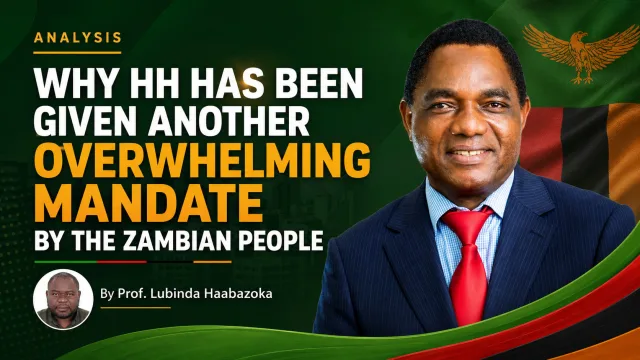
Picture: Mwebantu
By Prof. Lubinda Haabazoka
President Hakainde Hichilema’s re-election is not merely a political victory. It is an endorsement of the difficult economic decisions his administration made during its first term and a vote to protect the progress Zambia has achieved since 2021.
When President Hichilema assumed office, Zambia was confronting one of the most challenging economic situations in its history:
- The country was in external debt default.
• Inflation and the cost of living were rising.
• The Kwacha was under severe pressure.
• Foreign exchange reserves were inadequate.
• Investor confidence had deteriorated.
• Economic growth and employment creation had weakened.
Instead of pursuing short-term populist policies, the New Dawn Government adopted a disciplined and largely technocratic programme of economic reconstruction. It prioritised debt restructuring, fiscal responsibility, monetary stability, reserve accumulation and the restoration of investor confidence.
The administration understood that sustainable prosperity could not be built on excessive borrowing, uncontrolled spending and temporary political handouts. The foundations of the economy first had to be repaired.
Lakatips
Advertise on Lakatips
Reach readers following the national conversation
Display, sponsored placements and briefing slots — across politics, business and sport.
During its first term, Zambia:
- Secured a US$1.3 billion IMF-supported programme.
• Made substantial progress in restructuring its external debt.
• Rebuilt foreign exchange reserves to approximately US$6.5 billion—one of the strongest reserve positions in the country’s history.
• Restored economic growth towards the 5–6% range.
• Attracted renewed investment into the mining sector.
• Facilitated major expansions at Lumwana, Kansanshi and other mining operations.
• Adopted an ambitious long-term target of producing three million tonnes of copper annually.
• Introduced free education, enabling millions of children to access school.
• Expanded the Constituency Development Fund to unprecedented levels.
• Increased social cash transfers and other forms of support for vulnerable households.
• Recruited thousands of teachers, health workers and other public servants.
• Restored Zambia’s credibility among investors and international development partners.
The administration’s economic philosophy was straightforward:
“Repair the macroeconomy first, and then build sustainable growth, employment and prosperity upon that foundation.”
This approach was politically risky because macroeconomic reforms do not always produce immediate benefits. Debt restructuring is complex. Fiscal consolidation can be painful. Rebuilding reserves requires discipline. Restoring investor confidence takes time. New mining investments also take several years before translating into full production, exports, tax revenue and employment.
President Hichilema nevertheless chose long-term national recovery over short-term political convenience.
The Zambian people have now rewarded that courage and consistency. The overwhelming mandate represents public recognition that, although the cost of living remains a serious challenge and much work still lies ahead, Zambia is no longer where it was in 2021.
The economy has been stabilised. The debt crisis has been brought under control. Investor confidence has returned. The mining sector is expanding. Social investment has increased, and the foundations for stronger economic growth have been rebuilt.
Zambians have therefore voted to protect these gains rather than gamble with the country’s recovery. They have chosen continuity over uncertainty, stability over experimentation and economic reconstruction over empty political promises.
This renewed mandate is not a blank cheque. It carries an even greater responsibility. The second term must now translate macroeconomic stability into tangible improvements in people’s daily lives. It must deliver more jobs, lower living costs, affordable credit, reliable electricity, increased agricultural productivity, stronger local industries and greater opportunities for young people.
The first term was principally about economic repair and stabilisation. The second must be about accelerated growth, employment creation and broadly shared prosperity.
President Hichilema has been given another overwhelming mandate because the Zambian people have chosen to protect the progress already achieved and provide his administration with sufficient time to complete the economic transformation it began in 2021.
In the end, voters were presented with a fundamental choice: protect the gains or cover the country’s unresolved problems with political makeup.
They chose to protect the gains.
Source: Mwebantu — Read more
More to read
All Politics →
Hichilema rallies Africa to go digital or be left behind
PRESIDENT Hakainde Hichilema has called on African nations to urgently accelerate their digital transformation efforts, warning that failure to embrace digitalisation could leave the continent

Next Health Minister Must Be a ‘Mother or Father’ to the Sector —Dr Chibwe
As President Hakainde Hichilema prepares to appoint
Musokotwane, Haimbe return as ministers, as Hichilema warns new cabinet to perform or get sacked
President Hakainde Hichilema has warned newly appointed and returning ministers that failure to deliver on their mandates will not be tolerated, saying ministers who break ranks after Cabinet decisions will have to leave Government. Dr Situmbeko Musokotwane has been reappointed as Minister of Finance and…